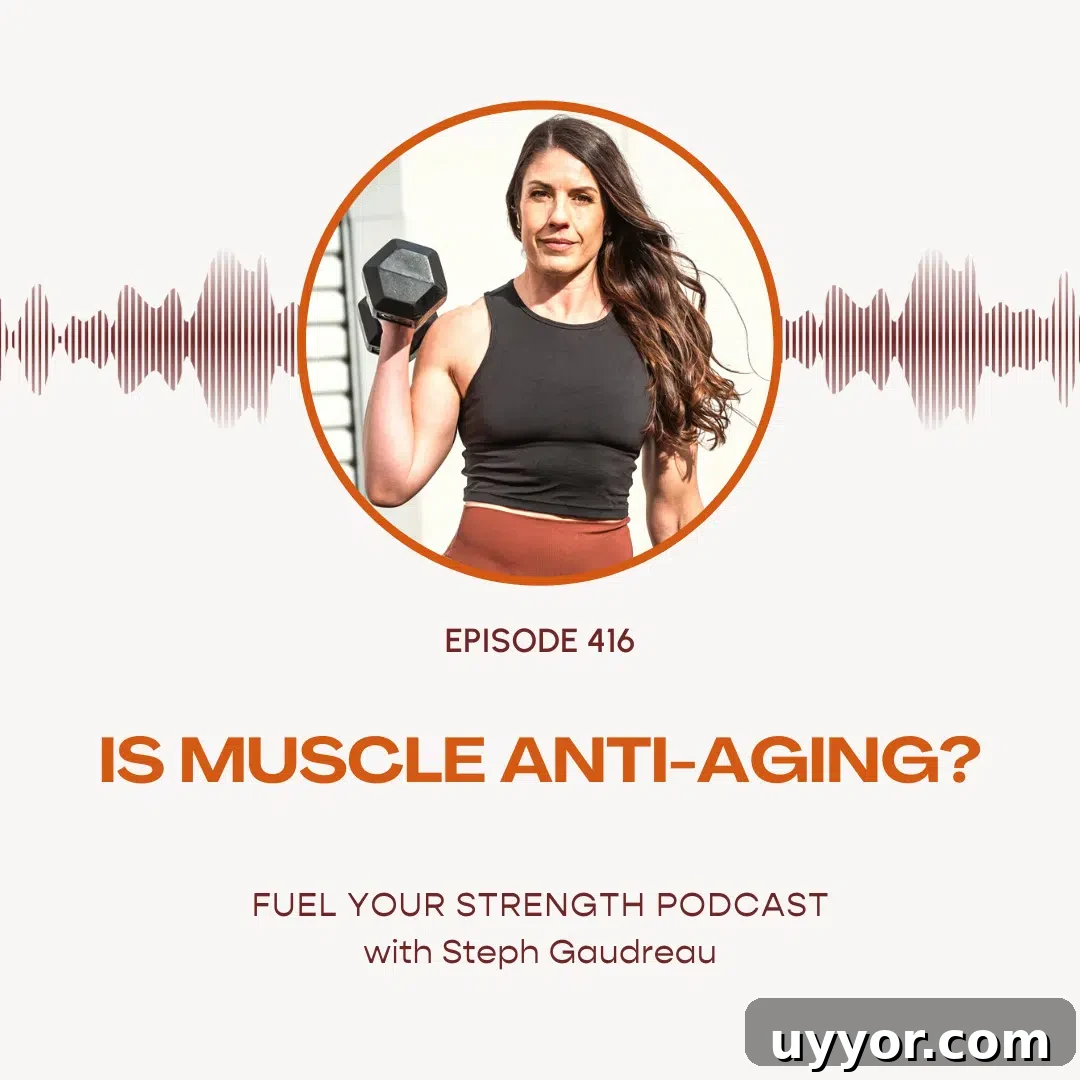
Our Western culture is frankly obsessed with anti-aging and the search for a fountain of youth. This multi-billion-dollar industry largely targets women and emphasizes products and treatments that preserve a youthful appearance on the outside. But too often we ignore what’s happening on the inside.
Click play to listen right on this page, no app needed:
Or listen on your preferred streaming platform: iTunes (Apple Podcasts) | Spotify | YouTube
Want a free week of strength workouts? Click here to get started
Watch the Episode on YouTube
Key Takeaways
If you want to use muscle to improve aging, start with these steps:
- Begin strength training now, if you haven’t already.
- Follow a progressive plan tailored to your goals and abilities.
- Work with a professional to take the next step and stay consistent.
Preserving Your Muscle and Quality of Life
Muscle is often the missing piece in conversations about aging. Maintaining muscle mass as we age is one of the most effective ways to preserve quality of life and support longevity, especially during the menopause transition and beyond. Building and preserving muscle not only improves how you feel but directly influences how well you move, recover, and live day to day.
The Unsung Hero of Anti-Aging
Strength training is the single best tool we have to reduce age-related muscle loss. Muscle mass isn’t just about appearance; it’s fundamental to function, independence, and long-term health. If you want to age with better mobility, strength, and vitality, muscle preservation needs to be a primary focus.
How has strength training changed your view of aging? Share your thoughts in the comments.
In This Episode
- What “anti-aging” really means in modern Western culture (4:45)
- Evidence-based statistics to frame the aging landscape (9:02)
- Why strength training matters, especially during menopause (13:21)
- The relationship between estrogen and muscle (17:11)
- Practical steps to preserve and build muscle as you age (25:02)
Quotes
“If there is one thing that gets missed over time and time and time again in the conversation about aging, it is the unsung hero, muscle.” (3:12)
“I don’t want to just live to be very old in terms of my years, but I also would like to have as much quality of life, and quality of health, as possible.” (8:29)
“No matter where on the spectrum you are, it is absolutely important and possible for you to start strength training now and reap some of these benefits.” (15:53)
“Not only does this affect performance in terms of sports and athletics and fitness, but also, life.” (21:48)
“This is all about your longevity, quality of programming, quality of life, and how strength training is going to serve you going forward.” (29:01)
Featured on the Show
Apply for Strength Nutrition Unlocked
Dynamic Dumbbells Program
Strong With Steph Program
Follow Steph on social media for updates and community support.
Please consider leaving a rating and review on Apple Podcasts if you enjoyed the episode.
Podcast production & marketing support by Counterweight Creative.
Related Episodes
FYS #411: Why You Need A Strength Training Program
FYS #408: Growth Mindset in Fitness
FYS #407: The Female Athlete Health Report with Kyniska Advocacy
Is Muscle Anti-Aging? Transcript
Anti-aging is an obsession in the Western world, but one critical topic is rarely discussed: muscle. This episode explores muscle’s central role in aging, strength, and long-term function. If you’re an athletic woman in your 40s who lifts, challenges yourself, and wants to perform and feel better, Fuel Your Strength is for you. You’ll learn how to eat, train, and recover smarter so you build strength and muscle, have more energy, and perform better in and out of the gym.
The podcast focuses on evidence-based approaches to nutrition, training, and recovery—especially relevant once you approach your 40s and beyond, when your body’s needs shift. We aim to challenge industry narratives and give you practical, science-backed tools.
If you’re ready to get serious about strength and muscle with coaching and community, consider applying to Strength Nutrition Unlocked. The program provides a framework and support so you can tailor your training and nutrition to your goals.
Our culture frequently focuses on outward signs of aging—skin, hair, and cosmetic changes—while overlooking internal changes like muscle loss. Starting around age 30, people begin to lose muscle mass at roughly 3–8% per decade, with the rate often accelerating as we get older. For women, hormonal changes during perimenopause and postmenopause—especially the fall in estrogen—can accelerate muscle decline. Some population-based statistics suggest that by the 80s, someone who takes no action could lose up to a third of their muscle mass.
Muscle loss is not merely cosmetic. It leads to reduced function and increases the risk of sarcopenia—the loss of both muscle mass and strength. That decline influences balance, mobility, and independence, and contributes to higher risk of falls and fractures. Bone health is also related, though this episode focuses primarily on muscle.
Menopause is a spectrum: perimenopause, the single day that defines menopause (12 months without a period), and the postmenopausal years after that. Hormonal fluctuations during perimenopause can cause unpredictable symptoms and can affect muscle maintenance. Regardless of where you are—pre-, peri-, or postmenopausal—the best time to start strength training is now. Progress is possible at any stage, and you can recover and rebuild lost tissue with consistent action.
Estrogen plays a role in maintaining muscle by promoting muscle protein synthesis and reducing breakdown. When estrogen declines, the balance can tip toward greater breakdown than synthesis, contributing to muscle loss. Strength and power may also decline: strength is force production, power is strength applied quickly. As those qualities decline, daily activities and sudden balance-correcting movements—like avoiding a fall—become harder. Some evidence suggests shifts in muscle fiber composition toward slower fibers, which reduces quick force production and power.
Training matters, but it’s only part of the equation. Nutrition, sleep, recovery, and stress all influence muscle-building outcomes. Building muscle requires appropriate calories and sufficient protein—older adults often face anabolic resistance, meaning they may need more protein and better nutritional support to stimulate muscle protein synthesis. Without the right raw materials, training alone can’t rebuild tissue.
So what should you do? Strength train consistently with a progressive plan that addresses strength, hypertrophy (muscle-building) ranges, and power. Strength work typically involves heavier loads and fewer reps; hypertrophy work uses moderate loads and reps to stimulate muscle growth; power work emphasizes speed and quick force production. All three play a role in preserving function and building resilience.
If you want help implementing a plan, consider outsourcing programming to professionals. Programs like Dynamic Dumbbells (for beginners) and Strong With Steph (for those with some lifting experience who want a long-term, progressive plan) are designed to remove guesswork and improve consistency. Having a structured app-based program with demos, reps, sets, intensity guidance, and progressions can free mental energy and make adherence easier.
In addition to training, prioritize adequate protein, sufficient calories, quality sleep, and stress management. These elements together support muscle protein synthesis and recovery. If you need a comprehensive system that combines fueling, training, recovery, and accountability, Strength Nutrition Unlocked provides coaching and a full framework for building muscle and improving performance.
To close, strength training is one of the most powerful actions you can take to influence how you age. It supports function, independence, and quality of life. Whether you’re just starting or returning to training, begin now, follow a progressive plan, and seek professional support if you need it. Stay consistent, nourish your body, and focus on strength, hypertrophy, and power to protect your future mobility and health.
Thanks for listening. Stay strong.