Using your Instant Pot as a slow cooker isn’t as simple as it may seem, but with the right approach you can get reliable slow-cooked results. This guide explains what to remember, how the Instant Pot slow-cook temperatures compare to a traditional slow cooker, and how to adjust settings and timing so your recipes turn out well.
Many people buy an Instant Pot to reduce clutter and replace single-use appliances. The Instant Pot excels at tasks like making rice and yogurt, often replacing dedicated rice cookers and yogurt makers. However, it is not a perfect replacement for a traditional Crock-Pot. The Instant Pot’s slow-cook function can work well, but it requires some adjustments to get results similar to a conventional slow cooker.
Important to Remember When Using an Instant Pot as a Slow Cooker
- Always include thin liquid. To reach and maintain a stable slow-cooking temperature, have at least 1 cup of thin liquid in the inner pot (water, broth, juice, etc.). The function will struggle or fail without sufficient thin liquid.
- Layer ingredients correctly. Keep thin liquid on the bottom of the inner pot. Thick sauces (BBQ sauce, tomato paste-based sauces, etc.) can prevent the cooker from heating evenly and maintaining temperature.
- Adjust settings and timing. The Instant Pot’s Low, Normal, and High slow-cook settings do not match one-to-one with a conventional slow cooker’s settings. Use conversion guidance to adapt recipes appropriately.
- Expect a short heat-up time. It should take no more than 15–20 minutes for the cooker to reach the slow-cook temperature. If it’s still heating after 20 minutes, the unit may be struggling; you can remove the lid, use the Sauté function for 2–4 minutes to help it warm, then cancel and restart the slow-cook cycle with the correct time.
- No pressure is reached. The slow-cook mode does not build pressure, so you do not need to lock the lid or set the venting knob. You can remove the lid to check on food during cooking. If you prefer some evaporation like a traditional slow cooker lid allows, a glass lid is useful.
Instant Pot Slow Cook Temperatures Explained
The Instant Pot slow-cook function offers three temperature options: Low, Normal, and High. They differ from a conventional slow cooker’s temperatures, so it helps to know the approximate ranges and how to adapt your cooking times.
- Low (Instant Pot) ≈ Keep Warm on a slow cooker: Reaches about 170°F. This setting is lower than a typical slow-cooker low and is useful for gentle, long holds.
- Normal (Instant Pot) ≈ Low on a slow cooker: Reaches about 200°F and is closest to the usual low setting on a traditional unit.
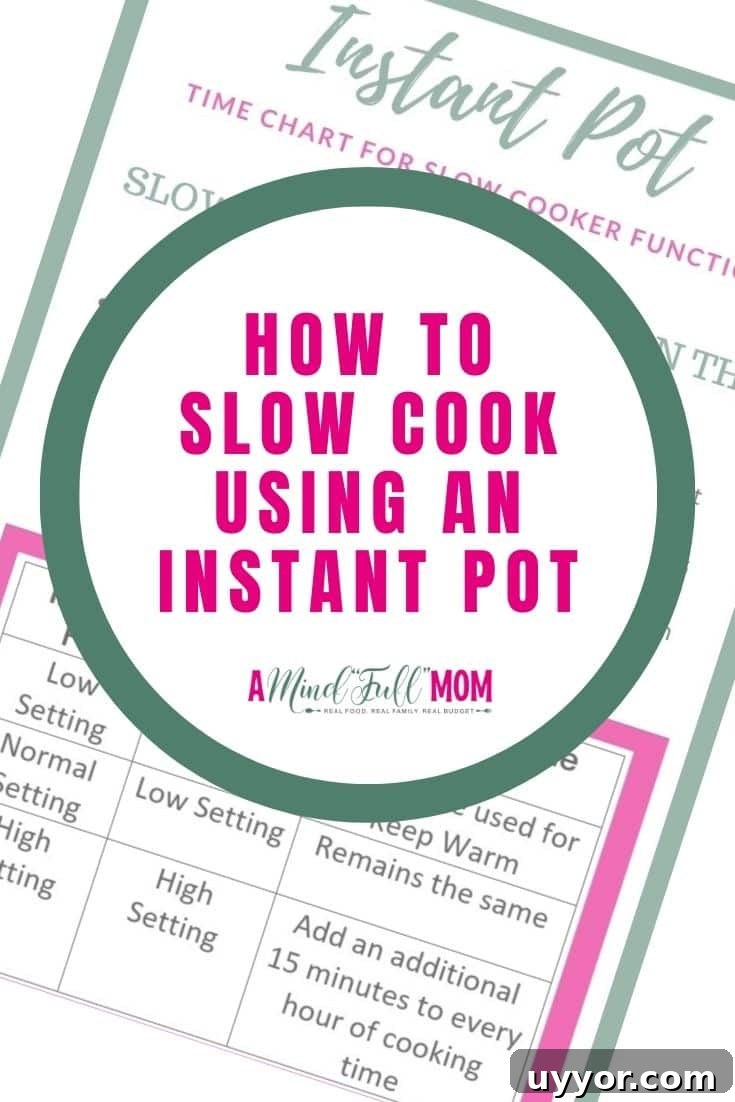
- High (Instant Pot): Reaches about 210°F, which is generally 10–20°F lower than a slow cooker’s high. To approximate slow-cooker high results, add roughly 15 minutes of cooking time per hour (for example, add 30 minutes for every two hours).
How to Use the Slow Cook Setting on the Instant Pot
Follow these steps to use the Instant Pot slow-cook function effectively. A printable conversion chart (image below) can help you quickly adapt slow-cooker recipes.
- Press the Slow Cook button on the Instant Pot.
- Use Adjust/Pressure or the control knob to choose Low, Normal, or High temperature.
- Set the cooking time with the knob or +/- buttons (often adjustable in 30-minute increments). If you choose High, add 15 minutes of cooking time per hour to better match traditional slow-cooker results.
- After setting time and temperature, the Instant Pot will heat. The countdown begins once the target temperature is reached.
- When cooking finishes, most models automatically switch to Keep Warm. Confirm Keep Warm is active if you want to hold the food.
Click on Picture to access the DOWNLOAD and print.
Should I Get Rid of My Slow Cooker?
No. If you have room for both, keep your slow cooker and Instant Pot. A traditional slow cooker delivers consistent results for many crockpot recipes and doesn’t require adding thin liquids to function properly. If you must choose one appliance, the Instant Pot is versatile and, with the right adjustments, can handle most slow-cooker-style dishes.
Slow Cooker Recipes to Instant Pot Recipes
The Instant Pot’s main advantage is speed, so converting slow-cooker recipes into pressure-cooker or faster Instant Pot versions often makes sense. Below are examples of slow-cooker recipes and the Instant Pot versions inspired by them.
- Slow Cooker Pork Carnitas converted to Instant Pot Pork Tacos
- Slow Cooker Steak Fajitas converted to Instant Pot Steak Fajitas
- Slow Cooker Baked Ziti converted to Instant Pot Creamy Pasta
- Slow Cooker Pulled Pork converted to Instant Pot Pulled Pork
If you have further questions, leave them in the comments and I’ll answer as best I can.